 thereprocase
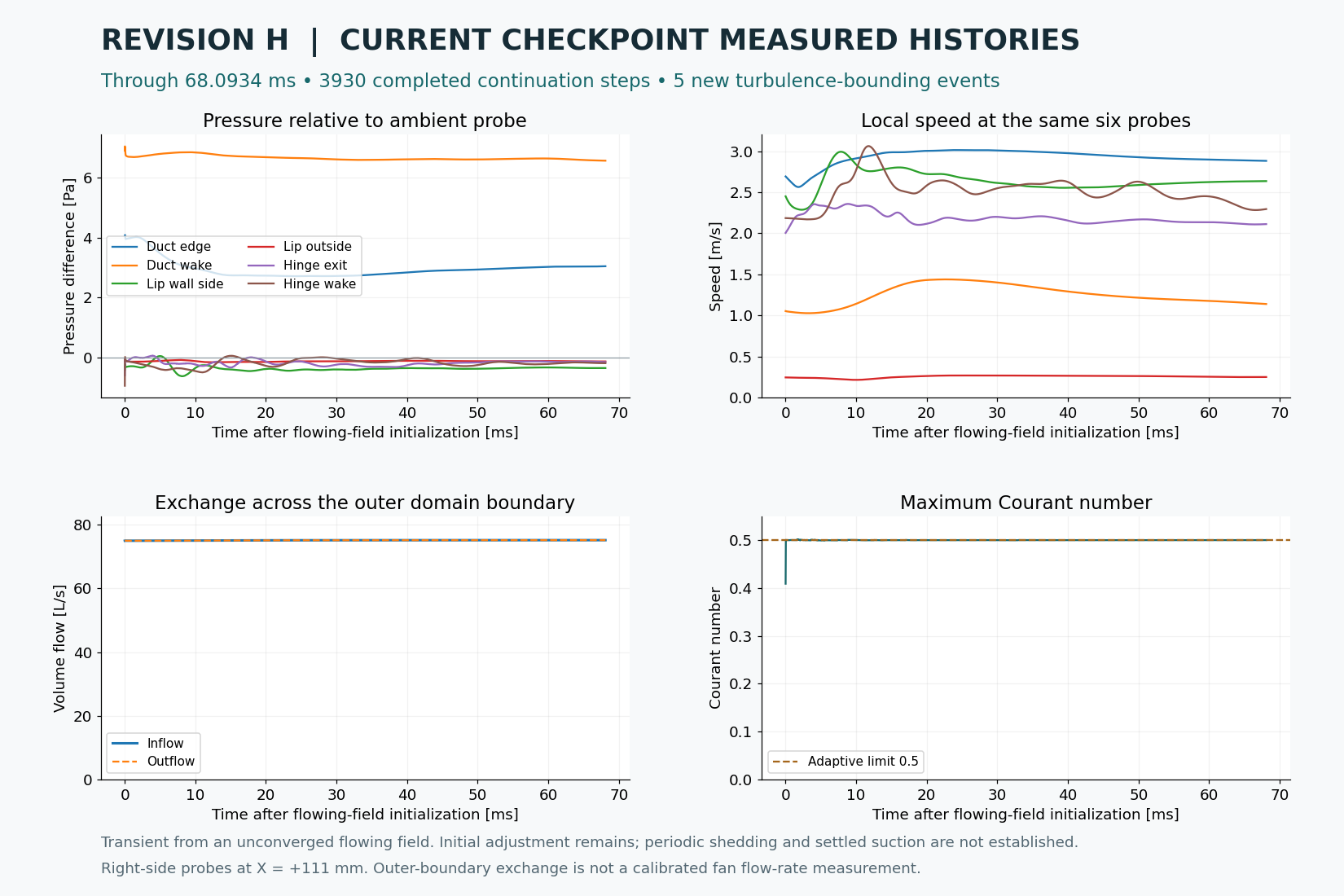
Final saved-field plots and complete probe histories now cover 69.44 ms, including the saved tail after this video.
Air is already moving in the first frame.
This separate transient begins with the flowing field from steady-solver iteration 400. Its clock starts at zero for this sequence. It is not appended to the original quiet-start simulation.
Simulation paused. The native restart checkpoint is preserved at 69.4402 ms, with previous-step history. These videos use the existing recorded samples. Automatic hourly publication is paused.
Follow the moving air · about 1/200th speed
Arrow-field view
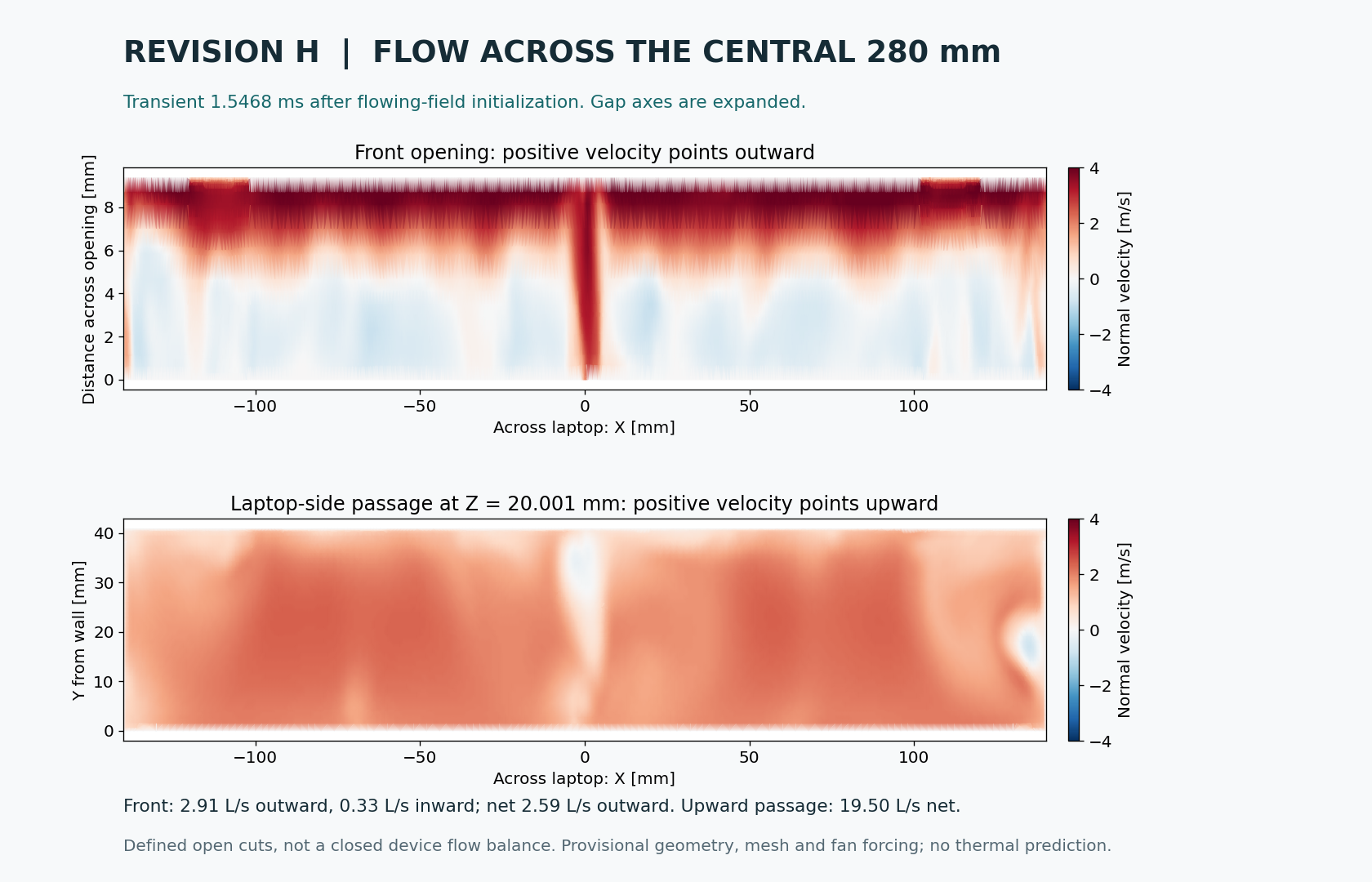
Where the front-opening flow goes
Preserved checkpoints
Checkpoint data remain available. Slower video downloads have been retired; local copies and source samples are preserved.
| Checkpoint | Transient time | Actual states | Files |
|---|---|---|---|
| checkpoint-01 | 0.9987 ms | 30 | Provenance · Diagnostics |
| checkpoint-02 | 2.8888 ms | 87 | Provenance · Diagnostics |
| checkpoint-03 | 6.4898 ms | 197 | Provenance · Diagnostics (gzip) |
| checkpoint-04 | 10.5656 ms | 314 | Provenance · Diagnostics (gzip) |
| checkpoint-05 | 14.7441 ms | 435 | Provenance · Diagnostics (gzip) |
| checkpoint-06 | 19.2612 ms | 563 | Provenance · Diagnostics (gzip) |
| checkpoint-07 | 23.5771 ms | 685 | Provenance · Diagnostics (gzip) |
| checkpoint-08 | 28.0572 ms | 812 | Provenance · Diagnostics (gzip) |
| checkpoint-09 | 32.1176 ms | 929 | Provenance · Diagnostics (gzip) |
| checkpoint-10 | 36.7060 ms | 1060 | Provenance · Diagnostics (gzip) |
| checkpoint-11 | 41.1650 ms | 1190 | Provenance · Diagnostics (gzip) |
| checkpoint-12 | 45.6416 ms | 1320 | Provenance · Diagnostics (gzip) |
| checkpoint-13 | 50.1812 ms | 1451 | Provenance · Diagnostics (gzip) |
| checkpoint-14 | 54.7267 ms | 1581 | Provenance · Diagnostics (gzip) |
| checkpoint-15 | 59.2968 ms | 1712 | Provenance · Diagnostics (gzip) |
| checkpoint-16 | 63.7543 ms | 1841 | Provenance · Diagnostics (gzip) |
| checkpoint-17 | 68.0934 ms | 1966 | Provenance · Diagnostics (gzip) |
How this run is initialized
The geometry, mesh and fan forcing match the original Revision H case. Velocity, pressure and turbulence fields are copied from the saved steady iterate; old transient history is not copied at initialization. The backward time scheme uses its native initial Euler fallback. The solver configuration uses 8 CPU workers, 2 outer correction passes, an initial 12.5 µs step, a maximum 25 µs step and an adaptive Courant target of 0.5. The run began with four workers and was checkpointed onto eight after a short field-equivalence and throughput comparison; physical time and native previous-step fields were preserved. Measured CPU scaling and checkpoint checks.
Arrows show sampled in-plane velocity at X = +111 mm. Colour limits are fixed within this sequence: speed 0–6 m/s, pressure ±12 Pa and vorticity ±2000/s. The original startup sequence retains its own scales. Grey areas are solid or unsampled; black lines are CAD surfaces.
Initialization provenance and settings · Mesh limitations · Dated solver status · Short correction-count comparison