R13 UPDATE 10 · DIFFUSER PROTOTYPE 5
Four straights and four corners
Each straight tilts 30° about its lower edge, so both optical pitches lean equally either side of vertical and the full lower edge sits on the bed. The corners print upright on a flat rim. Three vases make the set.
The riser frame stays unchanged.
Geometry and toolpath
Drag to orbit; right-drag or two fingers to pan; scroll or pinch to zoom. Double-click to reset. Full-size viewer · Image
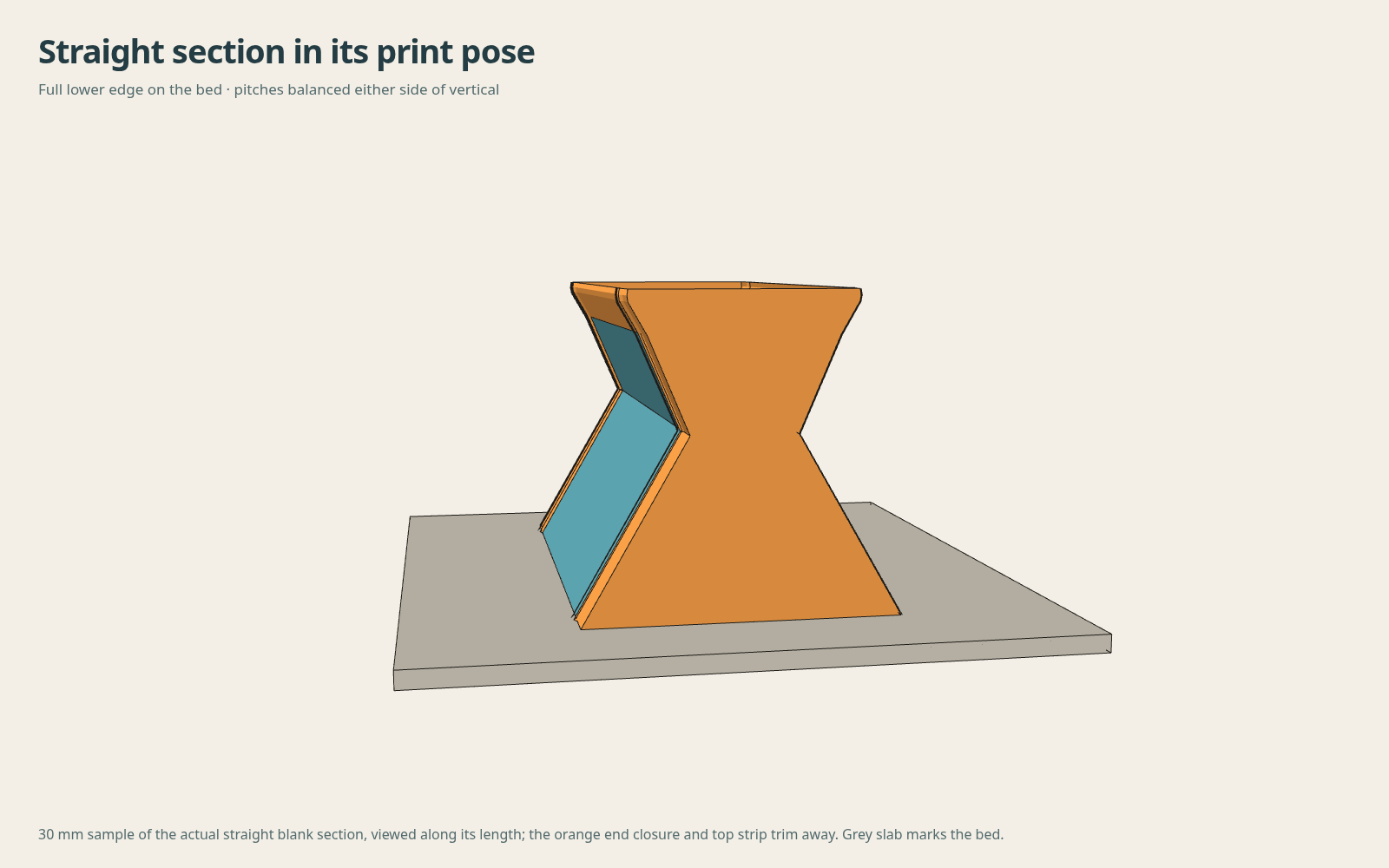
Teal stays; orange trims away. The first-layer brim is omitted from these views.
Straights
Faces at +30° and −30° from vertical in the print pose. Two equal straights face each other in one vase: front + back, then left + right.
198 mm square footprint on the bed diagonal, 21.5 mm tall. 0.20 mm layers.
27 min · 7.7 g and 25 min · 6.8 g per pair.
Corners
All four in one 106 mm vase, 14.4 mm tall, flat lower rim on the bed, folded faces at ±30°.
The last 4 mm of each corner blends into the straight's installed section so the joint lines up. That blend reaches 60° from vertical over its lowest 4.3 mm, so the corners use 0.12 mm layers.
24 min · 3.7 g.
Trim and fit
- Cut each straight free at the guide ridge nearest its end; the ridge's inner shoulder is the finished end.
- Separate the corners at the guide ridges either side of each short link.
- Trim the 0.8 mm top strip at the shallow groove's lower shoulder.
- Remove the brim, then fit one straight and one corner before trimming the full set.
All eight finished parts clear the frame and LED backing at 0, 0.8 and 1.6 mm lift; each joint keeps a 0.15 mm gap. In the actual G-code each blank is one continuous spiral with no travel or retraction, and the bead centreline stays within 0.08 mm of the CAD at the 99th percentile. Check results.
Prototype download
The STL files are solid envelopes for vase slicing: set zero bottom layers and thickness, and keep the supplied orientation. The STEP files show the trimmed parts.
Print and trim notes · Checksum · Download hash · Attribution